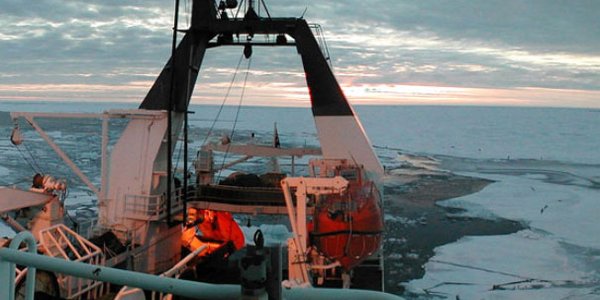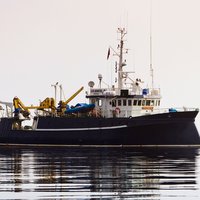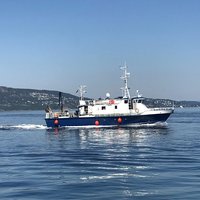



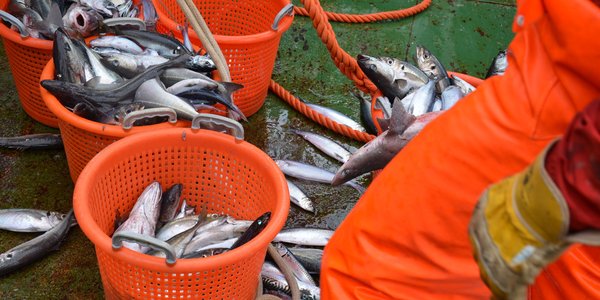
This attempt failed. The seamount was later famous in South Africa for their rich rock lobster fishery, sustaining a fishery of up to 80 000 rock lobsters. However, everything comes to an end and this valuable resource for restaurants were almost wiped out at the seamount in the mid 1980’s when the fishery became economically unsustainable. Now, more than 30 years later fishermen are again fishing intensively for rock lobster with traps at the same seamount (Figure 1). It is a huge dilemma and damaging for the marine resources that the international community cannot be able to regulate fisheries in a sustainable way in international waters including seamounts outside 200 nautical miles of national exclusive economic zones.

The last two days we have performed detailed mapping of the bottom topography, current system, oceanography and continuous acoustic fish and plankton registrations around this monumental seamount. The seamount rises from 5000 m depth on the seafloor all the way to the summit 11 m below surface for a distance of only a few kilometers.
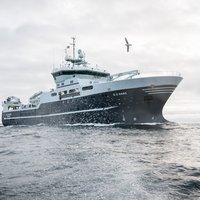
After leaving the Vema seamount, we suddenly observed some fascinating creatures in front of the bulb bow of G.O. Sars. “Look, flying fish!”, one of the scientists said enthusiastically. After that we had ‘flying fish safari’ for about an hour, although the number of flying fish we saw did not exceed 30 individuals. A small shark and a sea turtle were also joining us for a few seconds.

Flying fishes are really something on their own living in the ocean with their bird like appearance when they take off from the sea surface and glide into the air using their very large pectoral fins. Moreover, some species have unusually large pelvic fins giving them a four-winged appearance. The species we spotted is called blue flying fish (Exocoetus volitans), reaching 45 cm on length, and can adjust their direction while in air, to avoid enemies, using their tail just like a tiller on a ship (Figure 2). They are distributed in the Atlantic, Indian, and Pacific Oceans. Adults occur in surface waters, both near and far from the coast.
They can form considerable schools, but we only sighted one or a few individuals swimming and flying together. The blue flying fish are capable of leaping out of the water and gliding for long distances (> 100 m) above the surface depending on the wind speed and direction. They feed mostly on crustaceans and other planktonic animals, and are intensively preyed upon by e.g. fast swimming swordfish and tunas.
We have definitely left the Southern Ocean and are now on our way north to Walvis Bay in Namibia in sub-tropical warm waters with total different adapted animals inhabiting the ocean.
Written by![]() Leif Nøttestad, senior scientist at IMR, Bergen |