


|
07.04.2008
Catching plankton, fish and jellyfish |
Cruise diary
|
27.03.2008
"G.O. Sars" arrived in Walvis Bay, Namibia |
|
26.03.2008
Flying fish at Vema seamount |
|
24.03.2008
Growth experiments on Antarctic krill |
|
22.03.2008
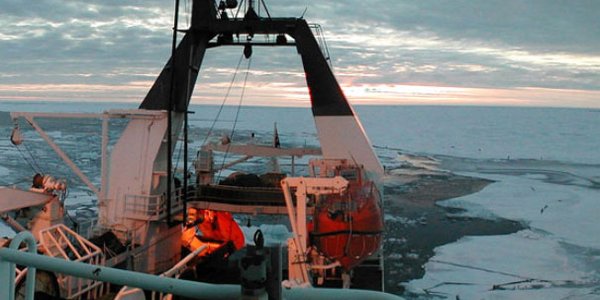
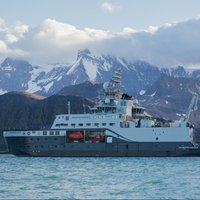
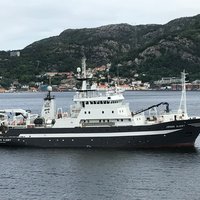
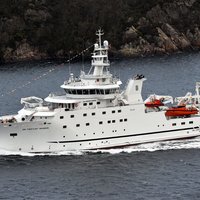
Whales in the Southern OceanThe whale observations in the Southern Ocean have been conducted on the bridge of G.O. Sars, which is an excellent platform for spotting different species of marine mammals and seabirds along our cruise track from Cape Town down to the Antarctic continent. We have so far documented eight different species, including sperm whale, minke whale, humpback whale and fin whale. |
|
21.03.2008
Antarctic krill - the key organisme in the Southern OceanAt 41°S in the southern Atlantic Ocean, on our way to Walvis Bay, Namibia, after weeks in waters with temperatures close to 0°C, we measured surface temperatures of 16°C. The distribution area of our main study organism, the Antarctic krill, is now left behind and we have started analysing our collected data. |
|
19.03.2008
Antarctic fish parasitesIt has been estimated that more than 50% of the species on earth are parasites, exploiting the remaining species acting as hosts. Parasites may interfere with almost any aspects of their host’s life; familiar to most are the effects on appetite and growth caused by tapeworms, but parasites may also cause disease and death (epidemics). |
|
18.03.2008
When small changes make huge differencesAcoustic surveys of krill, fish, and other marine animals requires a fundamental understanding of how sound transmitted from a transducer mounted on the ship's hull is reflected back from a target organism as it goes about living at some subsurface depth below the sea surface. The intensity of the returning echo is a measure of the target strength of a given individual at a particular sound frequency. But what determines an individual’s target strength? |
|
17.03.2008
Small organisms with large influenceAfter three weeks at sea the Bouvet Island raises in front of us with its magnificent glaciers and mountains during a moment of clear sky and sunshine. Some minutes later the Island is again covered in mist. At a research station close to the island the sampled Antarctic krill, Euphausia superba were extraordinary large (up to 6 cm long) with a greenish colour to stomach and gut. The krill feed on microalgae important in the Southern Ocean, and we found remnants of various diatoms when we investigated the gut content under a microscope. |
|
14.03.2008
The hunt for krill continues around the Bouvet islandThe Bouvet Island is the southernmost island on the Mid-Atlantic Ridge. It is situated in the middle of the Southern Ocean between Cape the Good Hope in South Africa and the Antarctic continent, at 54° 25’S and 3° 21’E. This small and uninhabited volcanic island measures 7 x 10 km, reaches 780m above sea level and 94 % of the surface is covered by a glacier. |
|
11.03.2008
The Brazilians on board "G.O. Sars"Scientists and crew on board “G.O. Sars” waited, with great expectations, for biological specimens collected from around 1200 meters deep. This was the first time that we used the larger fishing trawl, with an opening diameter of 520 m, to sample larger and deeper living organisms from the mesopelagic zone of the Southern Ocean. More than 2000 meters of wire was necessary to bring the trawl down to the deep. |
|
10.03.2008
Genetic analyses in stormy weatherAntarctica is well known and feared for the changing weather conditions, strong winds and high waves. On the other hand, it is important that analysis based on genetic variation in proteins (allozymes), are conducted with as fresh samples as possible. This means high quality results of the protein analysis, while samples for DNA studies are normally preserved in ethanol and can be analysed later in a molecular genetic laboratory. |
|
09.02.2008
Putting PIES into the oceanIn 2006 nine so-called “PIES” – Pressure sensor equipped Inverted Echo Sounders - were deployed to measure changes in surface level and transport of water mass of the Antarctic Circumpolar Current: Yesterday, we arrived at the first of three positions where a new PIES with fresh batteries was deployed. This PIES will measure water pressure at the ocean floor during the next 2 to 4 years. |
|
03.02.2008
A stone's throw away from the Bouvet Island |
|
02.02.2008
A small part of Norway |
|
01.02.2008
Producing freshwater on board |
|
29.01.2008
A few of the fish caught so farWe have skipped another few research stations due to the bad weather and we are now slowly making our way south. During this research cruise we have encountered several species not found in the waters where we normally do research. Merete Kvalsund and Jaime Alvarez have compiled a selection of the fish species caught so far: |
|
27.01.2008
Storm postpones our research activities |
|
24.01.2008
Half way through the AKES research cruise |
|
23.01.2008
Collecting data in the Antarctic Ocean |
|
22.01.2008
Studying the krill without disturbing itAcoustic measurements of krill are usually done by using echo sounders mounted on moving ships. Mounting echo sounders on platforms which are submerged and subsequently left alone for a day or two, however, yields a better understanding of the natural behavior of krill and other creatures found in the Antarctic waters. |
|
21.01.2008
Photographing krill echo |
|
19.01.2008
Significant climate changes in the Antarctic- Dramatic changes seem to happen in the Antarctic environment, which will not be without serious consequences for the ecosystem. A strong international effort to study at least parts of this vast ocean is needed, Volker Siegel argues. The German researcher at the fish research institute ISF in Hamburg has been on 20 research cruises in Antarctic areas over the last 30 years. On this cruise he is participating on the AKES project. Volker has written this cruise journal: |
|
18.01.2008
Trawling krill for the first time |
|
17.01.2008
Find filming krill, a tall order to fill |
|
17.01.2008
Calibration and visitation |
|
15.01.2008
Visiting Grytviken, South-Georgia |
|
11.01.2008
Testing the gear |
|
09.01.2008
Safety first |
|
08.01.2008
Expectations and challengesIt’s been a week since we left home and we are getting used to the blue sky and the sunshine. We left Montevideo on January the 4th and we are approaching the Falkland Islands where we will refuel and refill freshwater. It will be a special experience to visit this island that received so much attention when Argentina invaded it in 1982. |
|
07.01.2008
Southbound |
|
06.03.2008
Birds from Cape Town to the Antarctica |
|
26.02.2008
The role of the salps in the Southern Ocean |